
Description:
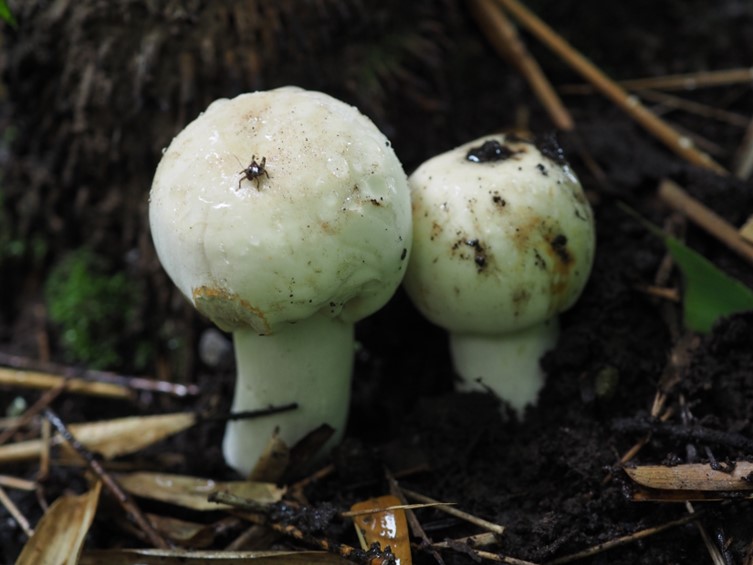
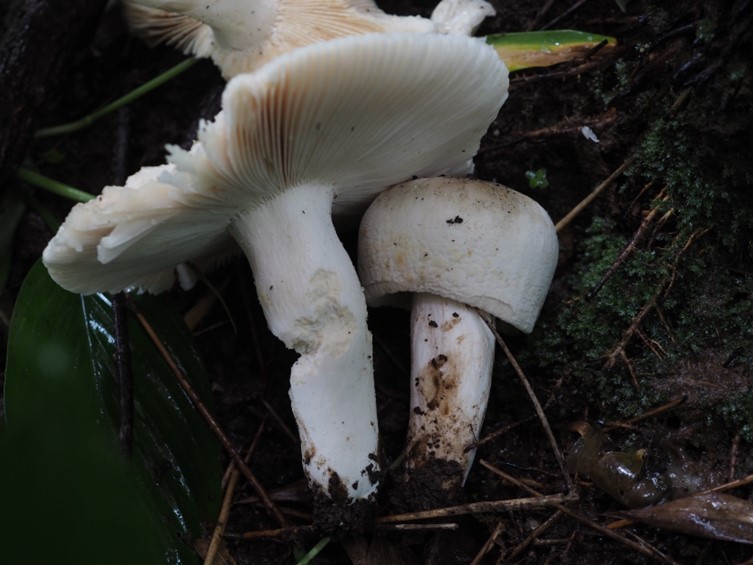
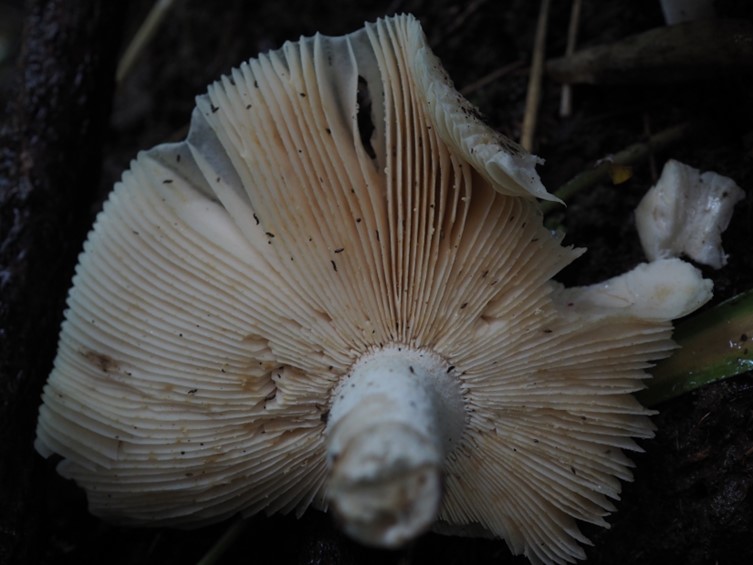
Basidiomata medium-sized, pileus 20–120 mm diam, plano-convex, surface is dry, with an even margin, and colored pale yellow to yellowish white, pale orange yellow, and pale yellowish pink. Chemical reactions: no color change with 3% potassium hydroxide (KOH), 10% ferrous sulfate (FeSO₄), or 10% ammonium hydroxide (NH₄OH). Lamellae sub-distant and pale yellow. Stipe 40–95 mm long and 15–25 mm wide, cylindrical, with a dry and smooth surface, colored yellowish white, pale yellow green, and pale yellow green. Chemical reactions: stipe changes from yellowish white to pale yellow with 3% KOH, to orange with 10% FeSO₄, and shows no reaction with 10% NH₄OH. The stipe is centrally attached. Basidiospores 5.25–7.5 × 5–7.5 µm, globose to subglobose, turning blue in Melzer’s reagent, ornamented with small spines (asperulate) about 0.25 µm in size. Basidia 33.25–42.5 × 8.25–12 µm, clavate to subclavate, 2–4 sterigmata, 2.5–6.25 µm long. Basidioles 25–47.5 × 7.5–11.25 µm. Cheilocystidia 17.5–40 × 7.5–12.5 µm, subcylindrical to fusiform. Pleurocystidia 62.5–80 × 10–13.75 µm, subcylindrical to fusiform. Hyphae of the pileipellis, 2.5–7 µm wide; terminal hyphae 1.25–5 µm wide. Stipitipellis hyphae 2.5–10 µm wide, moderately thick-walled, septate.
Species |
Strain |
Compound |
Pubchem CID |
Biological activity |
Reference |
|---|
|
Strain |
|---|