
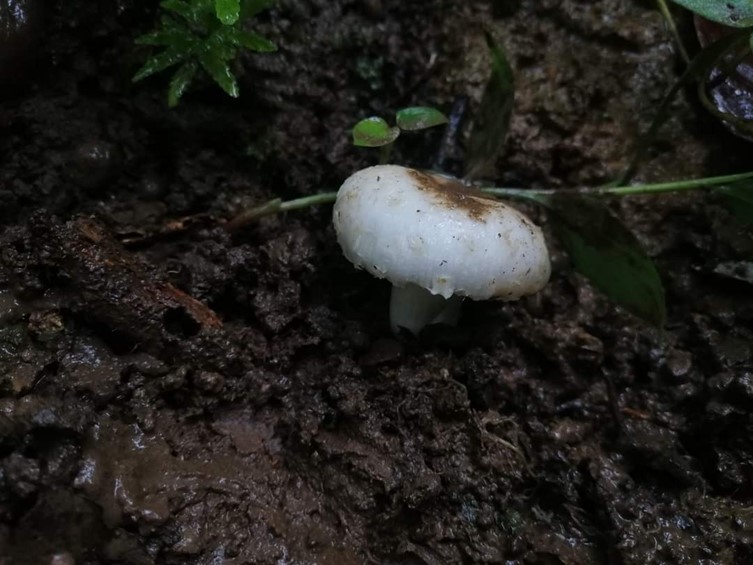
Description:
Basidiomata medium-sized, pileus 45 mm in diam., slightly depressed in the center (sub-umbilicate). The surface is dry, with an even margin, and is yellowish white. Chemical tests showed that the surface color changes from yellowish white to yellow when treated with 10% ferrous sulfate (10% FeSO₄), but no color reaction was observed with 3% potassium hydroxide (3% KOH) or 10% ammonium hydroxide (10% NH₄OH). Lamellae crowded, adnate to the pileus, and white in color. Stipe cylindrical, 3.5 cm long, dry in texture, and white. Chemical tests showed that the stipe changes from white to yellow when treated with 10% FeSO₄, while no reaction occurred with 3% KOH or 10% NH₄OH. Basidiospores 5–8 × 4.50–6 µm, are globose to subglobose, blue in Melzer’s reagent, and ornamented with small spines (asperulate) about 0.25 µm in size. Basidia 32.5–52.5 × 7.5–12 µm, clavate, and bear 2–4 sterigmata, each 2.5–5 µm long. Basidioles 32.5–47.5 × 7.5–12.5 µm. Cheilocystidia are 35–55 × 7.5–12.5 µm, clavate. Pleurocystidia 51.25–67.5 × 7.5–12.5 µm, clavate. Hyphae of the pileipellis 2–5 µm wide; terminal hyphae 2–5 µm wide. Stipitipellis hyphae 2.5–7.5 µm wide, with moderately thickened walls and distinct septa.
Reference:
Dutta AK, Paloi S, Pradhan P, et al. (2015). A new species of Russula (Russulaceae) from India based on morphological and molecular (ITS sequence) data. Turkish Journal of Botany39: 850–856.
Species |
Strain |
Compound |
Pubchem CID |
Biological activity |
Reference |
|---|
|
Strain |
|---|