
Description:
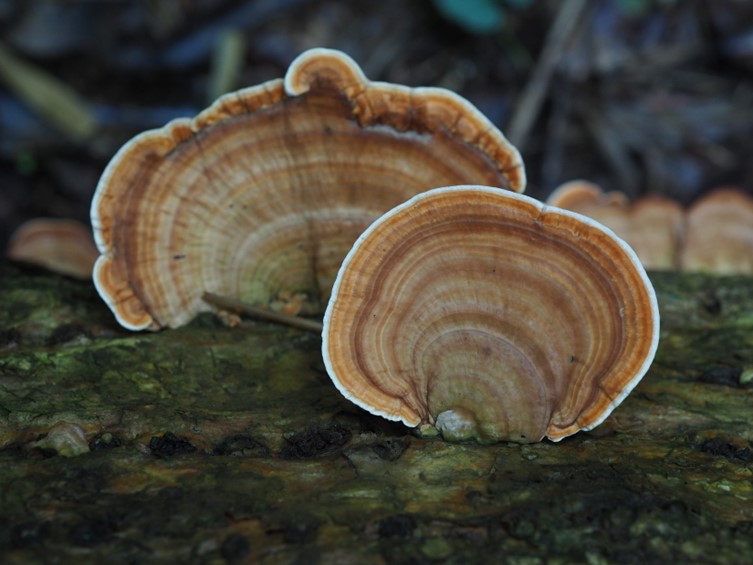
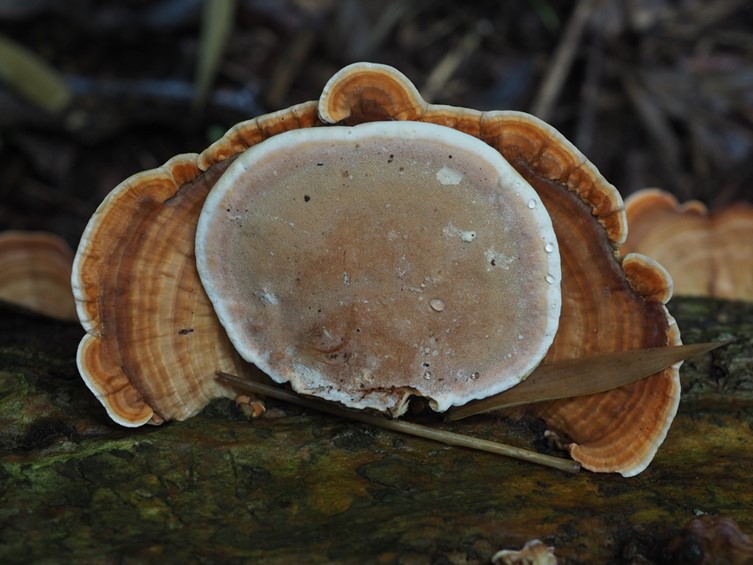
Basidiomata annual, 15−85 × 12−48 mm, 1−4 mm thick, effused-reflexed to pileate,deep orange yellow or brownish orange to moderate orange yellow. Pore surface olivaceous-buff when fresh, turning fawn on drying; sterile margin conspicuous, white in fresh state, cream-colored when dry, up to 0.5 mm broad. Pores angular, 8–10 per mm; dissepiments thin, generally entire. Subiculum cream-colored, corky, up to 1 mm thick. Tubes distinctly stratified, wood-hard to brittle; newly formed tubes concolorous with the hymenial surface, older tubes cream; tube layer reaching up to 4 mm in thickness. Hyphal system monomitic. Hyphae simple-septate, unchanged in KOH. Contextual hyphae hyaline, thick-walled with broad lumen, occasionally branched, frequently simple-septate, strongly flexuous, interwoven, 4–5 µm diam. Tramal hyphae hyaline to pale yellowish, thin- to distinctly thick-walled, with narrow to broad lumen, rarely branched, frequently simple-septate, moderately flexuous, interwoven, gelatinized, 3–5 µm diam. Hymenial elements. Cystidia present, ventricose with an acute apex, 15–21 × 7–8.5 µm; cystidioles absent. Basidia barrel-shaped, 4-sterigmate, with a simple basal septum, 6–7 × 3.5–4 µm; basidioles resembling basidia in form, but smaller. Abundant irregular crystalline deposits present within trama and hymenium. Basidiospores subglobose, hyaline, thin-walled, smooth, 3–3.5 × 2.8–3.3 µm.
Reference:
Wu F, Chen JJ, Ji XH, et al. (2017). Phylogeny and diversity of the morphologically similar polypore genera Rigidoporus, Physisporinus, Oxyporus and Leucophellinus. Mycologia109: 749–765.
Species |
Strain |
Compound |
Pubchem CID |
Biological activity |
Reference |
|---|
|
Strain |
|---|