
Description:
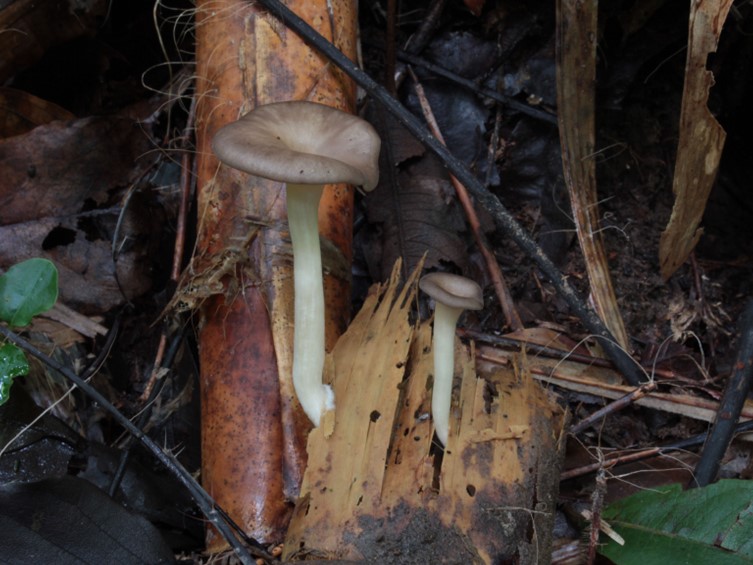
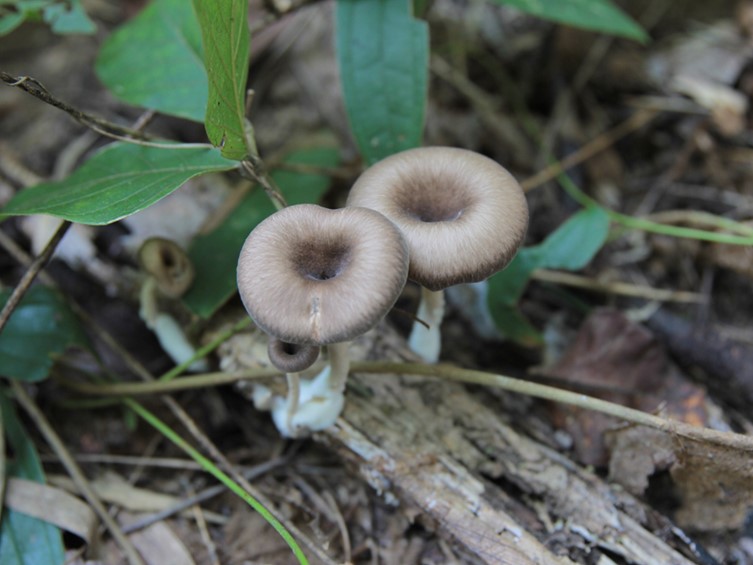
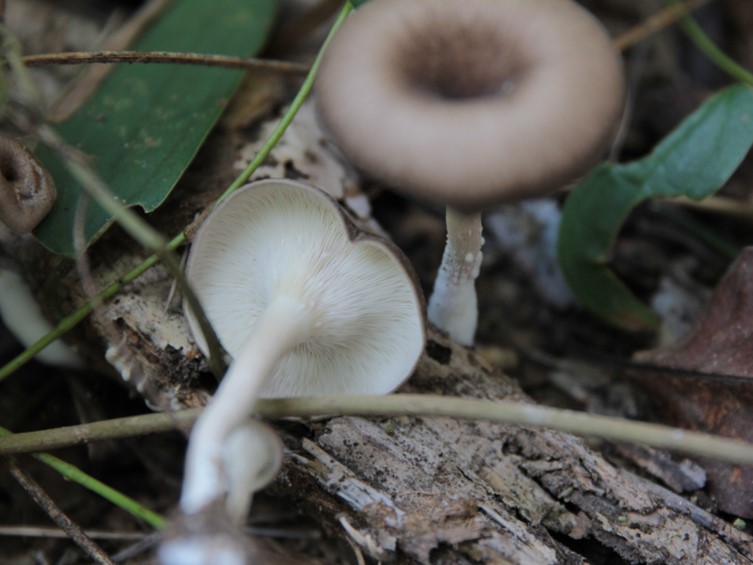
Basidiomata medium-sized, with pilei 22–45 mm in diameter, convex to plano-convex, occasionally flabelliform, sometimes with a shallow central depression. Pileus surface greyish-yellow to olive-brown, margin paler, inrolled when young, becoming straight at maturity; context thin, up to 2 mm, white. Lamellae short-decurrent, eventually separating from the stipe, white, thin, crowded, 1–2 mm broad; edges entire and concolorous; lamellulae arranged in 2–3 tiers. Stipe 20–40 × 5–15 mm, central to eccentric, cylindric, solid, surface concolorous with or slightly paler than pileus, base enveloped by white mycelium. Spore print white. Basidiospores 5–7.5 × 3.5–4.5 µm, ellipsoid to elongate, smooth, hyaline, inamyloid, non-dextrinoid, thin-walled. Basidia 10–16 × 4–5 µm, narrowly clavate, hyaline, 4-sterigmate, sterigmata cylindrical, up to 3.5 µm long. Cystidia: pleurocystidia absent. Cheilocystidia 15–18 × 4–5 µm, narrowly clavate to sublageniform, occasionally mucronate, hyaline, thin-walled, with basal clamp. Lamellar edge sterile. Hyphal system monomitic. Contextual hyphae hyaline, 2–4 µm wide, branched, thick-walled, with conspicuous clamp connections, non-skeletalized. Hymenophoral trama subregular to irregular, composed of thin-walled hyphae 2–3 µm wide and thick-walled hyphae 2–5 µm wide, clamped. Subhymenium interwoven, of frequently branched hyphae, 10–13 µm wide. Pileipellis a cutis of radially arranged, thin-walled, hyaline hyphae, 1–3 µm wide, clamped, often terminating in coralloid to finger-like hyphal tips (5–15 × 2–4 µm). Stipe hyphae resembling those of the context: thin-walled 2–5 µm wide and thick-walled 3–5 µm wide, clamped. Clamp connections abundant throughout all tissues.
Reference:
Suwannarach N, Kumla J, Satienperakul K, et al. (2020). Pleurotus sirindhorniae (Pleurotaceae, Agaricales), a new species from northern Thailand. Phytotaxa460: 285–295.
Species |
Strain |
Compound |
Pubchem CID |
Biological activity |
Reference |
|---|
|
Strain |
|---|