
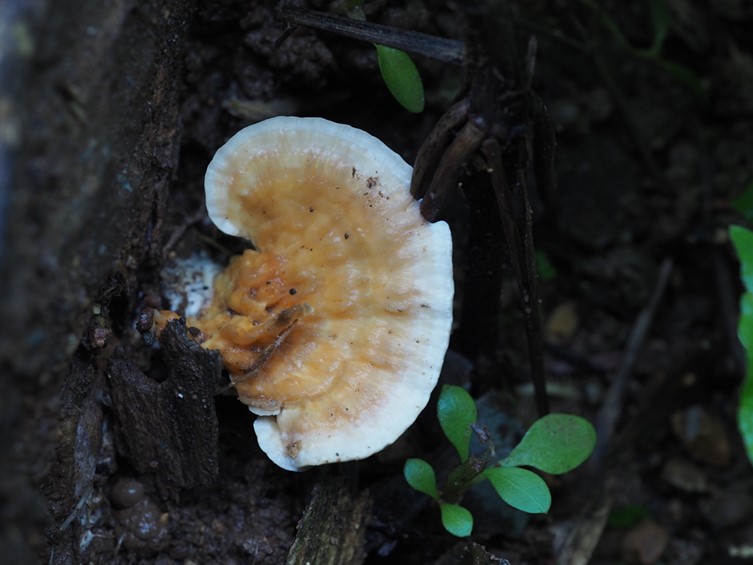
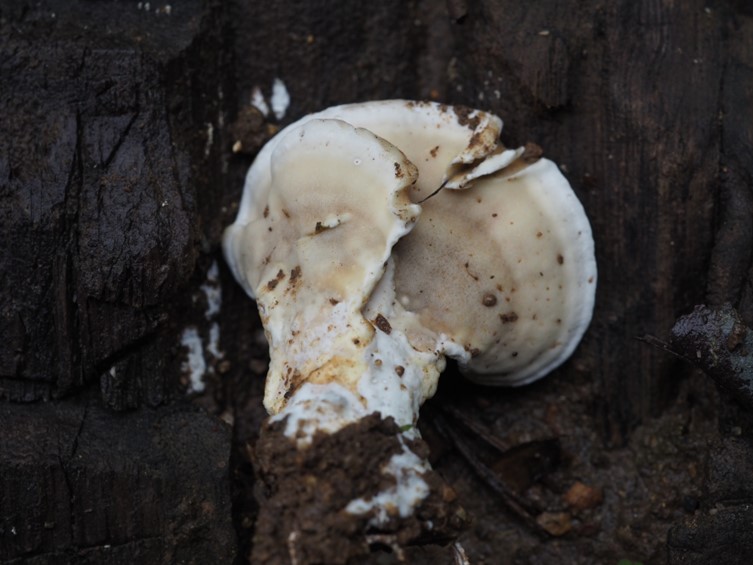
Description:
Basidiomata annual, effused–reflexed to resupinate, leathery in fresh condition, lacking any distinctive taste or odor, becoming corky-hard to bony-hard when desiccated; effused portion attaining up to 74 × 35 mm. Pileus flabelliform to elongate, reaching 40 mm in length, 56 mm in width, and 3.5 mm in thickness. Pileal surface buff-yellow, ivory to cream, glabrous, generally azonate when fresh; upon drying turning olivaceous-buff to bluish-grey, glabrous, lacking grooves and concentrically zonate appearance; margin not blunt, curved in dried condition. Hymenophore poroid. Pores ivory to cream in fresh specimens, bruising yellowish, drying clay-buff to greyish-brown, bruised areas becoming dark brown on drying; sterile margin distinct, white when fresh, buff-yellow to cream when dried, c. 1 mm broad. Pores angular to rounded, 8–10 per mm; dissepiments thin, even. Context buff, firm, corky-hard to woody upon drying, approximately 1.5 mm thick. Tubes concolorous with pore surface, bone-hard to corky-hard when dried, up to 2 mm long.
Reference:
Wang CG, Dai YC, Kout J, et al. (2024). Multi–gene phylogeny and taxonomy of Physisporinus (Polyporales, Basidiomycota). Mycosphere15: 1455–1521.
Species |
Strain |
Compound |
Pubchem CID |
Biological activity |
Reference |
|---|
|
Strain |
|---|