
Description:
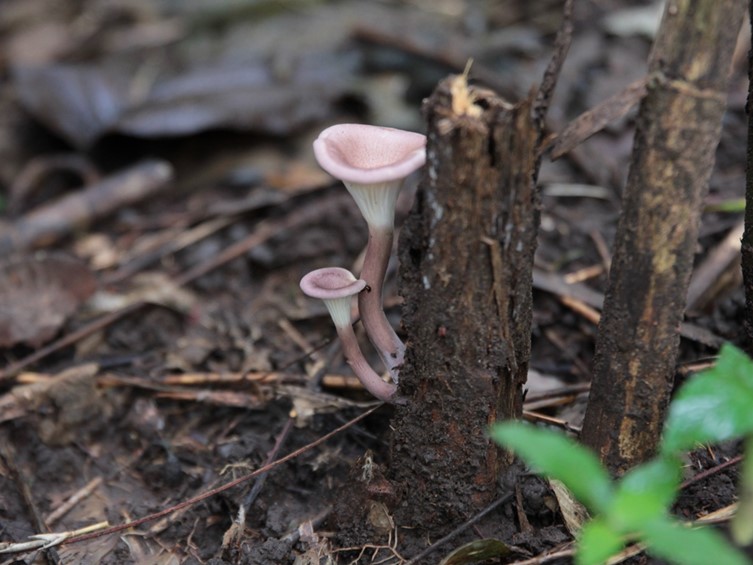
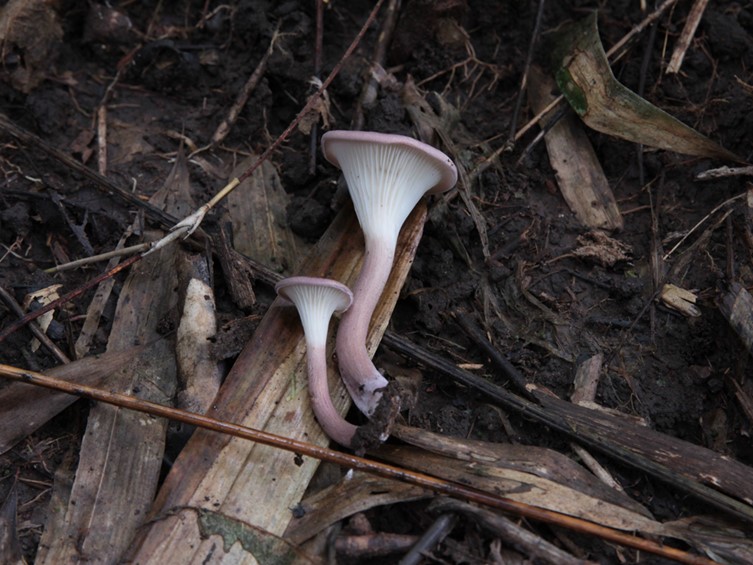
Basidiomata ranging from small to rather large. Pileus 13–65 mm in diameter, initially convex with a depressed disc, soon becoming infundibuliform; surface reddish-grey at a very young stage, rapidly fading to dull white, and later aging to pale yellowish-white to yellowish-white; ornamentation of very fine, appressed squamules at first, soon appearing glabrous to the naked eye, especially when moist, though finely hairy under magnification; pileus initially finely striate toward the margin, becoming conspicuously sulcate-striate at maturity. Margin entire and slightly incurved in young basidiomata, later straight, finely denticulate to fimbriate, and irregularly lobate when mature. Lamellae strongly decurrent, yellowish-white, up to 1.2 cm broad, close, frequently interveined and often dichotomously furcate, with lamellulae arranged in 3–4 series; edges appearing entire macroscopically, but finely fimbriate under magnification, concolorous with the sides. Stipe 4–10 × 0.5–2.5 cm, central, nearly equal when young, gradually tapering toward the base with age, terete, solid; surface dull white to yellowish-white at first, turning brown to dark brown at maturity, nearly glabrous in very young specimens but becoming tomentose, with a covering of matted fibrils or strigose hairs, sometimes forming erect, pointed squamules through agglutination. Base not originating from a sclerotium or pseudosclerotium. Context up to 7 mm thick at the pileus centre, white, fleshy. Odor indistinct. Spore print white.
Reference:
Arun Kumar TK and Manomohan P (2005). A new species of Lentinus from India. Mycotaxon92: 119–123.
Species |
Strain |
Compound |
Pubchem CID |
Biological activity |
Reference |
|---|
|
Strain |
|---|