
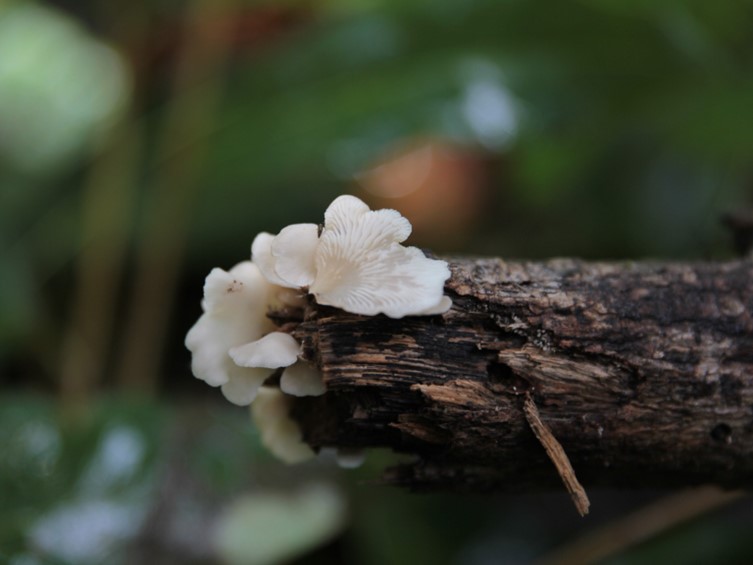
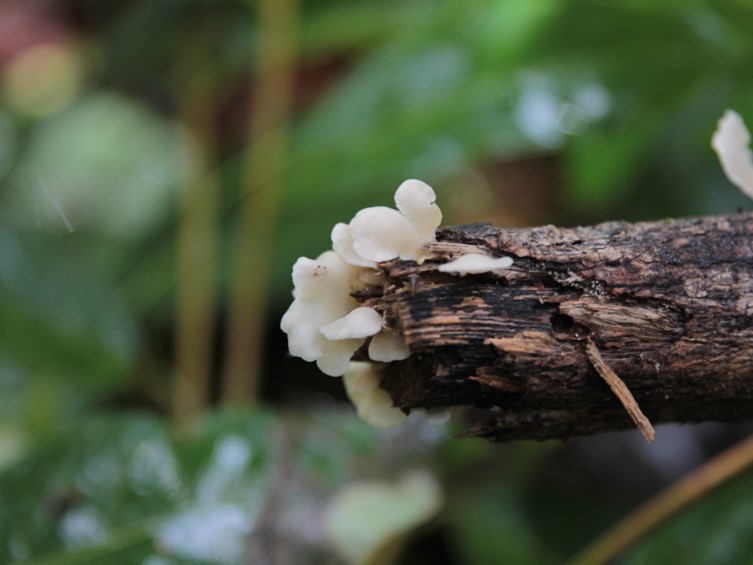
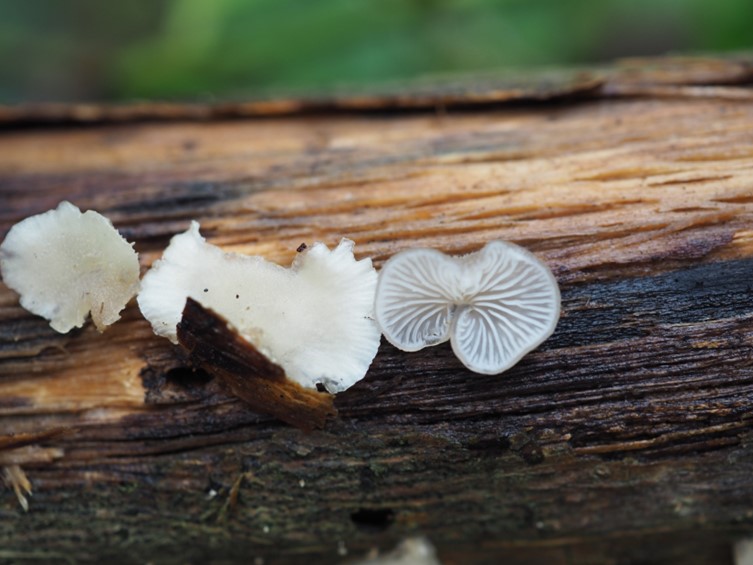
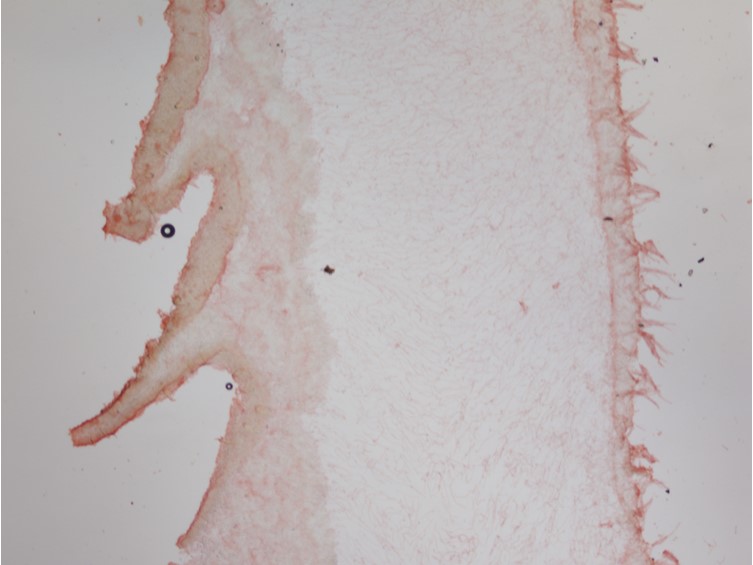
Holotype:
Thailand, Chiang Mai province, Mae Rim district, Ban Saluang Nok Community Forest, 19 Aug. 2019, U. Pinruan, S. Sommai, P. Khamsuntorn, BBH 47885.
Description:
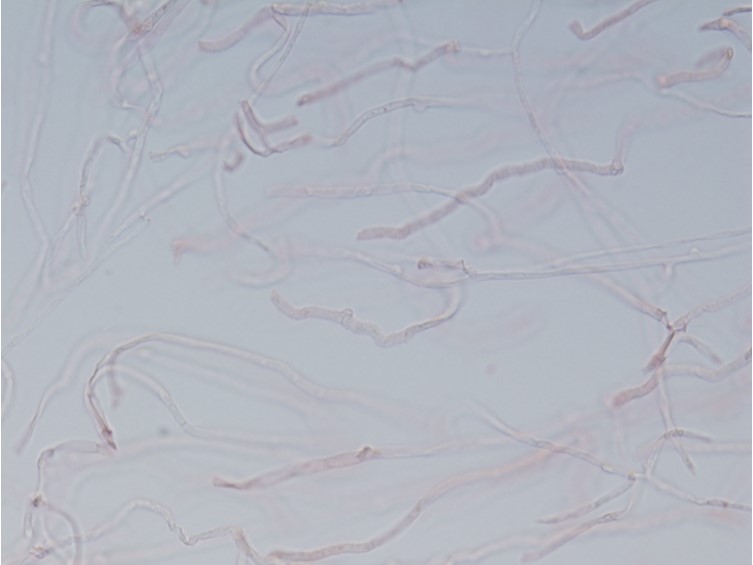
Basidiomata leathery, spatuliform, flabelliform, reniform, orbicular, laterally or dorsally attached to the substratum without stipes or pseudostipes, 5–30 mm broad × 8–20 mm high. Pileus surface white to yellowish white, greenish white, turning to moderate orange yellow when dried, paler towards margin, white woolly (under lens) dense near base, sparse elsewhere; nonhygrophanous, nonstriate, dry; with margin in rolled to incurved when young, becoming straight, entire to variously lobed or wavy. Lamellae white to yellowish white, turning to moderate orange yellow when dried, radiating from point of attachment, subdistant, unequal. Stipes or pseudostipes absent. Hymenophoral trama irregular, 30–70 µm thick, made up of hyaline, branched, 2.5–5 µm wide hyphae with clamp connection and with ampulliform swelling up to 17.5 µm wide and 2.5 µm thick. Tomentose or hispidulous layer 150–260 µm thick, composed of thin-walled, hyaline, up to 5.0 µm wide, with clamp connections, erected from the epicutis. Pileus trama subregular, 180–340 µm thick, composed of interwoven, gelatinized, thin-walled, hyaline, septate, branched, 2.0–5.0 µm wide hyphae with clamp connections and with ampulliform swelling up to 22.5 µm wide and 1.25 µm thick. Pileipellis 37.5–167.5 µm thick, consisting of an interrupted ixocutis of septate, thin-walled, hyaline, up to 5.0 µm wide hyphae with clamp connection. Pileocystidia absent. Gelatinous subpellis or Gelatinized zone 300–870 µm thick, compose of thin-walled, hyaline, septate, branched, 1.25–2.5 µm wide hyphae with clamp connection. Subhymenium pseudoparenchymatous 7.5–12.5 µm thick.
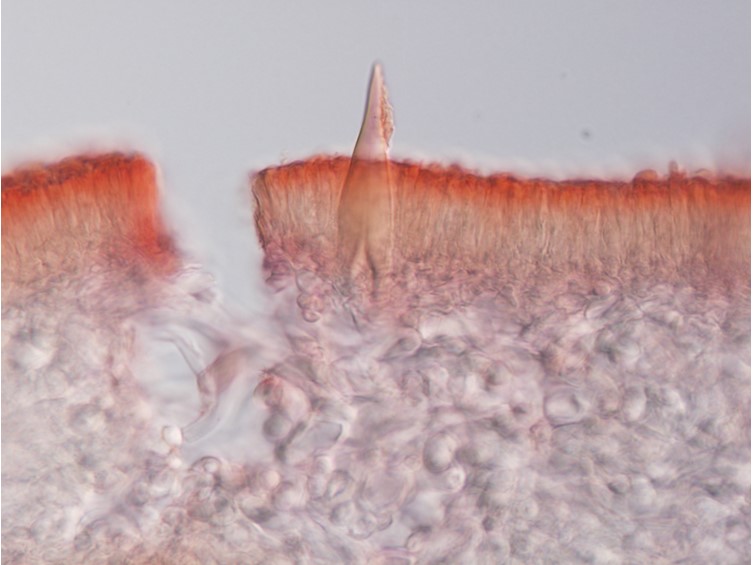
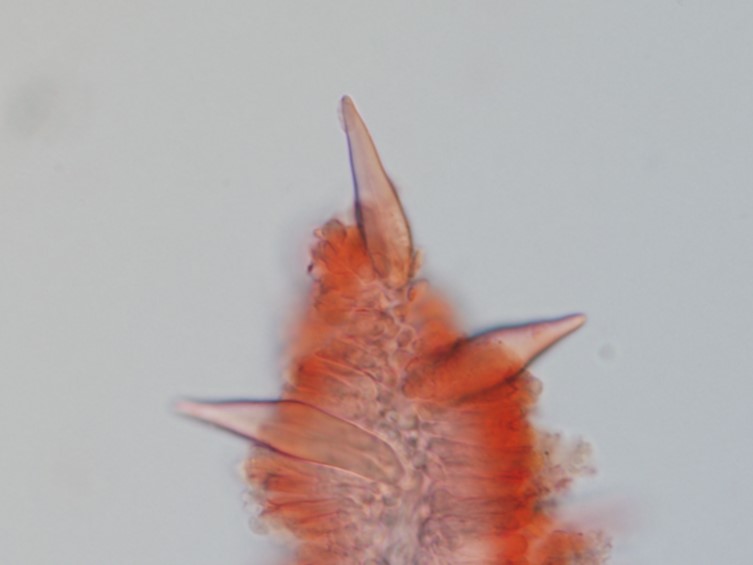
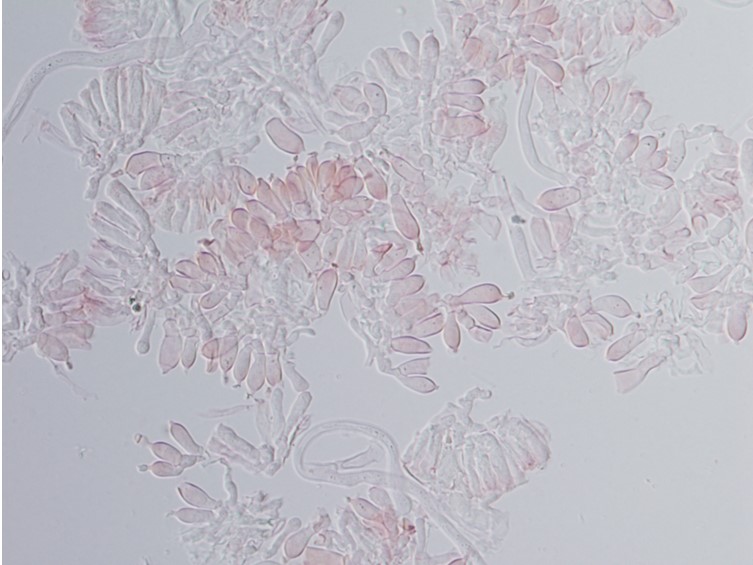
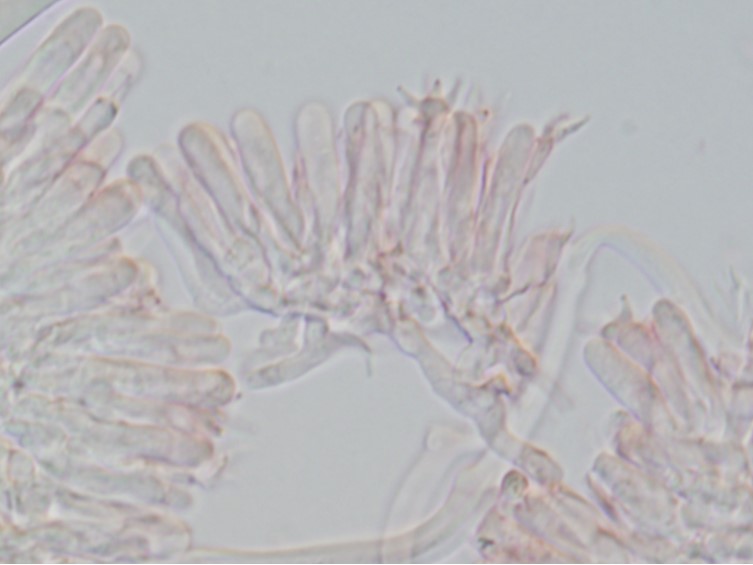
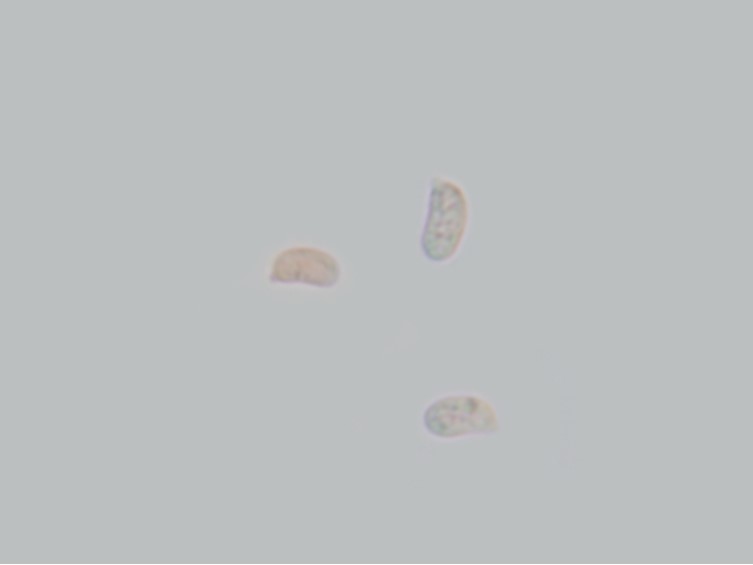
Basidiospores inamyloid, hyaline with dull granular content or with one or more oil drops, smooth- and thin-walled, allantoid, some reniform, 5–7.5(–7.8) × 2.5–3.5(–3.8) µm. Basidia hyaline, thin-walled, clavate to subcylindrical, 15–20 × 3.5–5.0 µm, with 2-4 sterigmata of 2.5–5.0 µm long. Cheilometuloids fusoid to lanceolate with the apical part covered partly with refractive encrusted crystals, thick-walled (3–3.75 µm thick), isolated or in groups at the lamellar edge, prominently projecting from the hymenium, 32.5–62.5 × 7.5–15.0 µm. Cheilocystidia smooth- and thin-walled, lecythiform to sub lageniform, 12.5–20 × 5–7.5 µm, with a neck and capitulum and sometimes with one swelling protruding from the apical portion. Pleurometuloids, fusoid to lanceolate, with the apical part covered partly with refractive encrusted crystals, thick-walled (5–7.5 µm thick), isolated, prominently projecting from the hymenium along both sides of the lamellar, 37.5–105 × 8.75–20.0 µm
Reference:
Stevenson G, (1964). The Agaricales of New Zealand. V. Tricholomataceae. Kew Bulletin19: 1–59.
Species |
Strain |
Compound |
Pubchem CID |
Biological activity |
Reference |
|---|
|
Strain |
|---|