
Description:
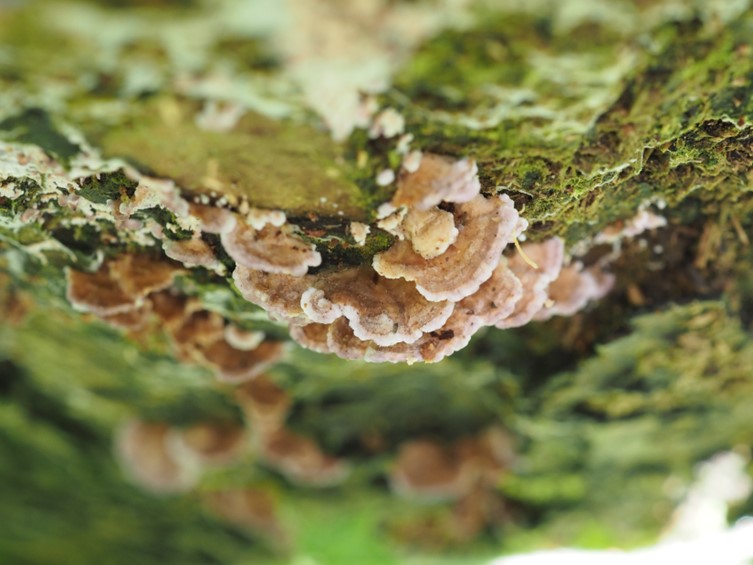
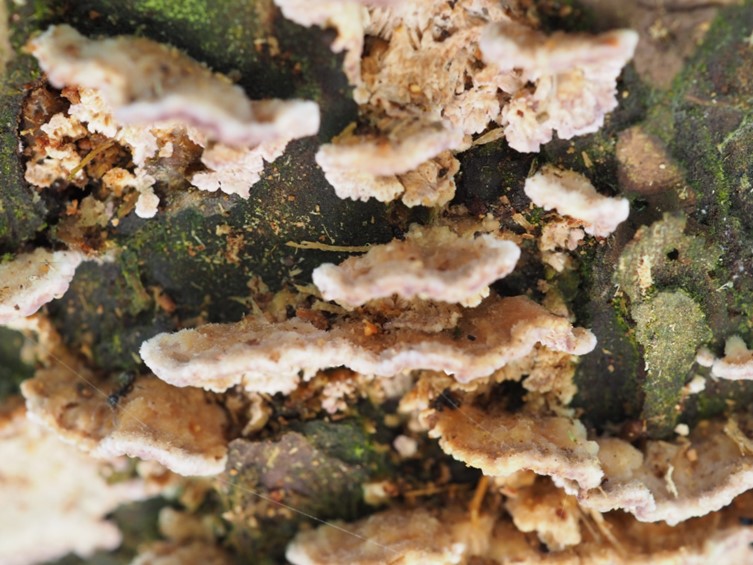
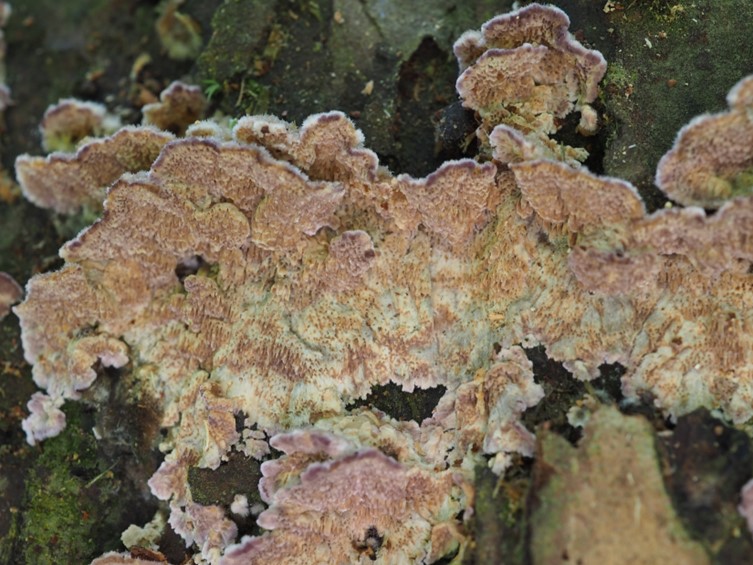
Basidiomata annual, effused-reflexed to pileate; pilei small, typically imbricate, often laterally conjoined. Pileal surface yellowish grey, concentrically indistinctly sulcate or azonate; surface pubescent to velutinate in youth, becoming sparsely to closely adpressed-velutinate with age; margin concolorous with the pileal surface, more distinctly purplish in juvenile specimens. Hymenophore poroid, bright purplish when young, fading to ochraceous with maturity; pores angular, 3–5 per mm; dissepiments entire at first, becoming markedly lacerate with age. Context duplex, generally less than 1 mm thick; upper layer whitish, floccose, soft; lower layer white, firm to tough-fibrous. Tubes concolorous with pore surface, delimited from context by a thin gelatinous layer. Cystidia fusoid, thick-walled, abundant, usually apically encrusted, embedded or protruding from hymenium up to 15 µm in length, 4–6 µm broad. Hyphal pegs present. Basidiospores cylindrical, slightly curved, hyaline, smooth-walled.
Reference:
Zhou M, Dai YC, Vlasák J, et al. (2023). Revision and updated systematics of Trichaptum s.l. (Hymenochaetales, Basidiomycota). Mycosphere14: 815–917.
Species |
Strain |
Compound |
Pubchem CID |
Biological activity |
Reference |
|---|
|
Strain |
|---|