
Description:
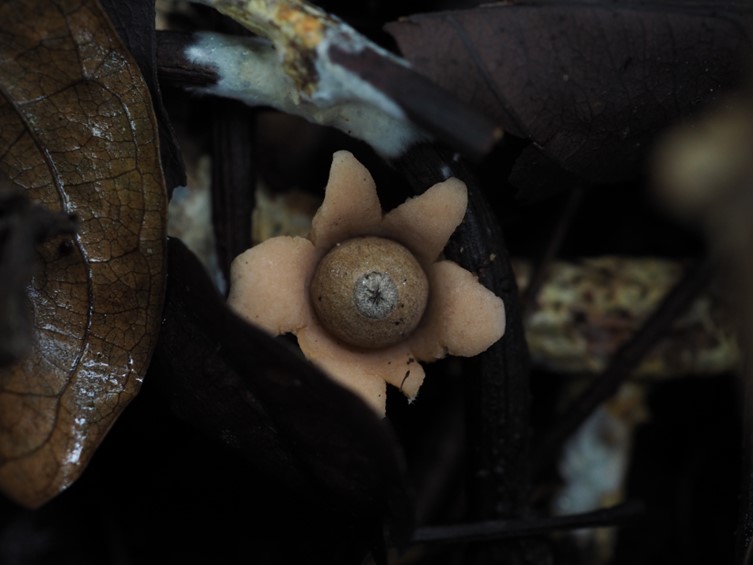
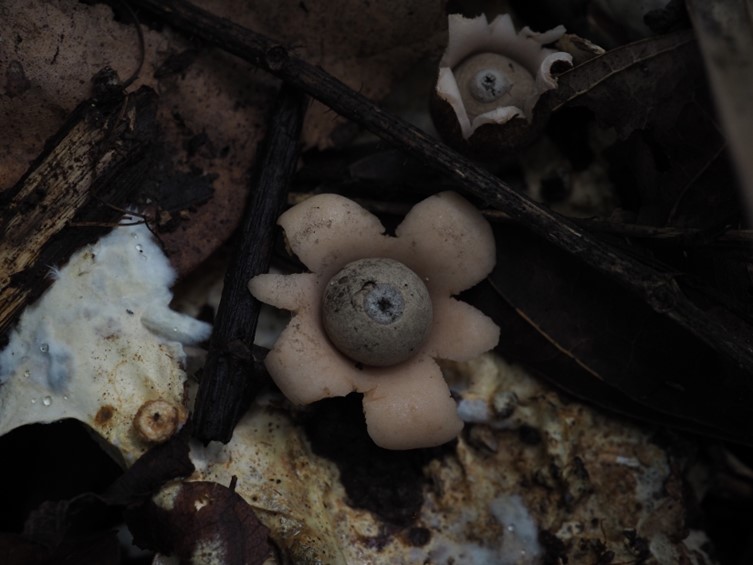
Basidiomata dark reddish-brown, 10–24 mm in diam., often with white mycelial tufts, emitting a faint chocolate-like odor. Expanded basidiomata small to medium-sized, 14–23 mm in diam. Exoperidium shallowly to deeply saccate, splitting at maturity into 5–7 lobes, each 5–10 mm broad, tapering distally; rays non-hygroscopic. Pseudoparenchymatous layer with smooth surface, brownish-grey, contracting along lobe margins or bases and fragmenting, easily exfoliating, forming an aseptic collar. Fibrous layer grey, firmly adherent to the underlying mycelial layer. Mycelial layer surface ornamented with small, reddish-brown, pyramidal tufts of villi, producing an areolate pattern reminiscent of lychee rind; firmly attached, not easily detachable, and lacking debris encrustation. Basidiospores globose, 2.5–4 µm diam., yellowish-brown to dark brown in 5% KOH; ornamentation consisting of short columnar processes 0.5–1 µm long, non-amyloid; under SEM, processes distinctly columnar. Capillitial hyphae 2–7 µm diam., thick-walled, pale to yellowish-brown, mostly unbranched though some with short branches, occasionally longer branches, often with dense surface incrustations.
Reference:
Wang X and Bau T (2023). Seven New Species of the Genus Geastrum (Geastrales, Geastraceae) in China. Journal of Fungi9: 251.
Species |
Strain |
Compound |
Pubchem CID |
Biological activity |
Reference |
|---|
|
Strain |
|---|