
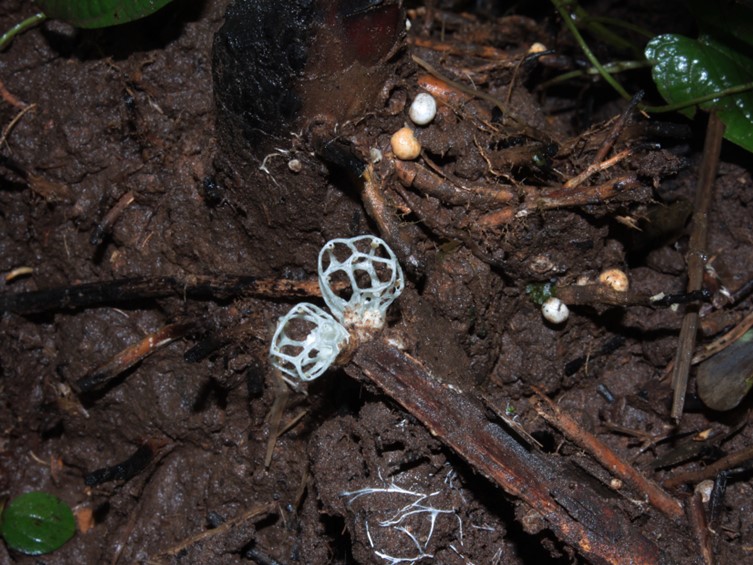
Description:
Immature basidiomata (“myco-eggs”) originating from robust, whitish mycelial cords running over woody debris; globose to ovoid, white to pale orange, up to 10 mm diam., rupturing apically to expose the expanding receptacle enclosed in a mucilaginous layer. Receptacle hollow, latticed, 13–18 × 9–12 mm, chalky white; meshes numbering c. 10–12, polygonal, irregularly branched, approximately isodiametric near the apex and vertically elongate toward the base, where the arms coalesce to form a short stipe. Arms smooth, flattened, distinctly sulcate along the outer surface. Gleba olive-brown, initially coralloid, mucilaginous, breaking down into jelly-like masses confined to the inner surfaces of the receptacle, especially toward the apical intersections of arms, borne on specialized structures resembling three-legged stools. Volva pale white to light orange, membranous, enclosing the basal portion of the receptacle. Basidiospores ellipsoid, 3.5–4.5 × 1–2 µm, smooth, hyaline.
Reference:
Swapna S, Abrar S, Manoharachary C, et al. (2010). Development and morphology of Clathrus delicatus (Phallomycetidae, Phallaceae) from India. Mycotaxon114: 319–328.
Species |
Strain |
Compound |
Pubchem CID |
Biological activity |
Reference |
|---|
|
Strain |
|---|